AgTech News
Wild Bioscience Ltd Acquires F1 Seed Ltd to Create Britain's First Independent Precision-Breeding Wheat Business
28th July 2026
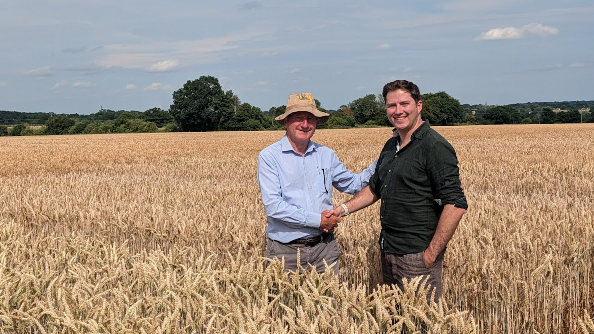
•Acquisition unites Oxford University AI-led biotech spinout with UK wheat breeding pipeline.
•Integrated seed company will aim to tackle 30-year stagnation in UK wheat yields and save struggling farms.
Oxford, United Kingdom – 28th July 2026 – Wild Bioscience Ltd (Wild Bio), a University of Oxford spinout that designs improved crops for resilient agriculture, today announced the acquisition of F1 Seed Ltd, an independent wheat breeding business led by Bill Angus, one of the most respected figures in British wheat.
By joining forces with F1 Seed, Wild Bio becomes a fully integrated, end-to-end UK seed company, positioning it to challenge agrochemical multinationals and directly address the escalating crisis in British agriculture.
The acquisition unites two halves of the same solution to crop improvement. F1 Seed Ltd brings proven decades of breeding excellence and a diverse germplasm pipeline built over more than a decade; Wild Bio brings evolutionary biology, gene editing, and AI-led trait discovery for precise genetic improvement. Together they form a single business able to design, breed, and deliver new wheat varieties to growers end-to-end.
By pairing scientific advancements in gene editing with a deep breeding pipeline, the integrated business can pursue traits more efficiently than either could on its own, across yield, stability, and disease resistance, and translate them into varieties to address the needs of local growers.
British farming is at a tipping point. UK wheat yields have remained flat for 30 years, while input costs have soared and climate change has introduced unprecedented volatility. 2025 and 2026 brought two consecutive exceptionally dry, hot springs to England, with 2025 the driest in over 100 years and 2026 the warmest spring on record. In 2025, this contributed to a 13% drop in yield compared to the 10-year average. Similar yield penalties are predicted to become the norm, rather than the exception; much of England's wheat farming areas could lose 10-25% of their productive potential due to climate change in the coming two decades. The financial toll is severe. Most farms operate on very thin margins, and approximately one third of UK farms are currently loss-making and considering exiting the industry.
With this acquisition, Wild Bio will be able to offer UK farmers a solution, providing seeds developed with cutting-edge technology and designed specifically for UK conditions.
Wild Bio searches for the genetic solutions that evolution has developed to improve plants in the past, and uses these discoveries to design simple fixes for today’s crops. This means that the Wild Bio platform can uncover nature-tested solutions that have already been validated in the wild across a suite of conditions that challenge plant growth, such as drought, heat, and flooding.
By building unique plant biology datasets and applying ML/AI tools to find signatures for how evolution has historically built better plants, the Wild Bio platform can precisely target specific traits and activate them in key crops like wheat. This is done using precision breeding, which can bring about changes that could theoretically be achieved by conventional breeding, but would take a prohibitively long time to accomplish.
The genetics underpinning Britain's wheat, the country's largest arable crop, which generates roughly three billion pounds in a typical year, have been dominated historically by the subsidiaries of foreign multinationals. Over decades, the UK's wheat pool has narrowed, leaving more than 50% of domestic wheat varieties vulnerable to yellow rust (a devastating fungal disease).
F1 Seed was specifically built to broaden genetic diversity and protect farmers from this kind of widespread crop failure. Meanwhile, Wild Bio is designing its traits and breeding new varieties here in the UK, for local growers, as an independent company. As food security and supply chain resilience climb the national agenda, this move builds a strategically important part of the food system at home.
F1 Seed already has six wheat varieties on the UK market, primarily focused on animal feed and distilling, with three more launching this year. Of the 82 new wheat varieties entering official UK national trials this year, 12% (10 entries) come directly from F1 Seed’s pipeline.
This combination is also made possible by England's decision to lead on the science with the Genetic Technology (Precision Breeding) Regulations, in force since November 2025, which create a route to market for targeted gene edits that could have arisen through traditional breeding. Wild Bio is exactly the kind of company this framework was built to enable: an AI-led science business, spun out of a world-leading university, scaling into a strategically important sector and building capability in the proximity of its growers. It is a practical example of the country's bet on AI-driven discovery turning into productivity and jobs, applied to one of the world's oldest and most foundational industries.
Dr Ross Hendron is Co-Founder and CEO of Wild Bio and a co-inventor of the University of Oxford science that Wild Bio is built on. Ross said:
“Wheat is Britain's biggest crop and feeds a fifth of humanity. But on a changing planet, growing it is only getting harder. That's the challenge we exist to meet. As a new independent seed business that brings breeding and gene editing together, we can focus on the traits that growers genuinely need and design towards them with precision. Bill and his team have built something remarkable; pairing their strengths with our evolutionary platform gives us the full stack of capabilities we need to develop the varieties that will bend the yield curve upwards again.”
Bill Angus is Founder and Director of F1 Seed Ltd and for two decades built and ran what was then the UK's largest wheat breeding programme at Nickerson and Limagrain. Bill said:
“This is the most exciting news for wheat growers since Cambridge University established the Plant Breeding Institute in 1912. That organisation established the blueprint for integrating new traits into cereals. Now over a century later, armed with an array of novel traits, we are well placed to move wheat breeding into a new and exciting era. Deploying traits has been the lifeblood of wheat breeding – now we have the opportunity to accelerate this in UK germplasm.”
Dr Stuart Harrison is Chief Business Officer at Wild Bio and, over a 24-year career at Syngenta, a leading global seed company, held senior leadership roles in seed research and product development, open innovation, and venture capital. Stuart said:
“By acquiring F1 Seed, Wild Bioscience evolves from a trait discovery and licensing business to a full seed company. This gives Wild Bioscience all the capabilities of a larger seed company with the agility of a start-up, which is extremely rare in the seed industry and a clear differentiator from the incumbents. The UK is a perfect starting point as stagnating wheat yields and challenging agronomic conditions are the perfect target for the Wild Bioscience platform.”
About
Wild Bioscience Ltd is a plant science spinout from the University of Oxford that develops next-generation resilient crops for a food-secure future. Wild Bio was founded by Ross Hendron and Steve Kelly in 2021 to put millions of years of plant evolution to work improving crops. The startup uses evolutionary biology, AI, and gene editing to design traits to drive higher-yielding, lower-carbon farming. Wild Bio has raised $75m from The Ellison Institute of Technology, Oxford Science Enterprises, Braavos Capital, and the University of Oxford, and is based in Oxfordshire.
F1 Seed Ltd is an independent wheat breeding business founded by Bill Angus in 2014. Bill previously spearheaded the UK’s most extensive wheat breeding initiatives at Limagrain and spent seven years on the board of CIMMYT, a leading international non-profit dedicated to agricultural resilience and global food security. Under his leadership, Suffolk-based F1 Seed has grown to become the UK’s largest independent wheat breeding operation, achieving in just 10 years what previously took 16 years in major multinational programmes.
Bill has a history of innovation, introducing winter sowing of spring wheat, hybrid wheat and novel genetics to the UK market. Key varieties introduced by Bill’s previous team included Claire, Einstein, Istabraq and Crusoe.